



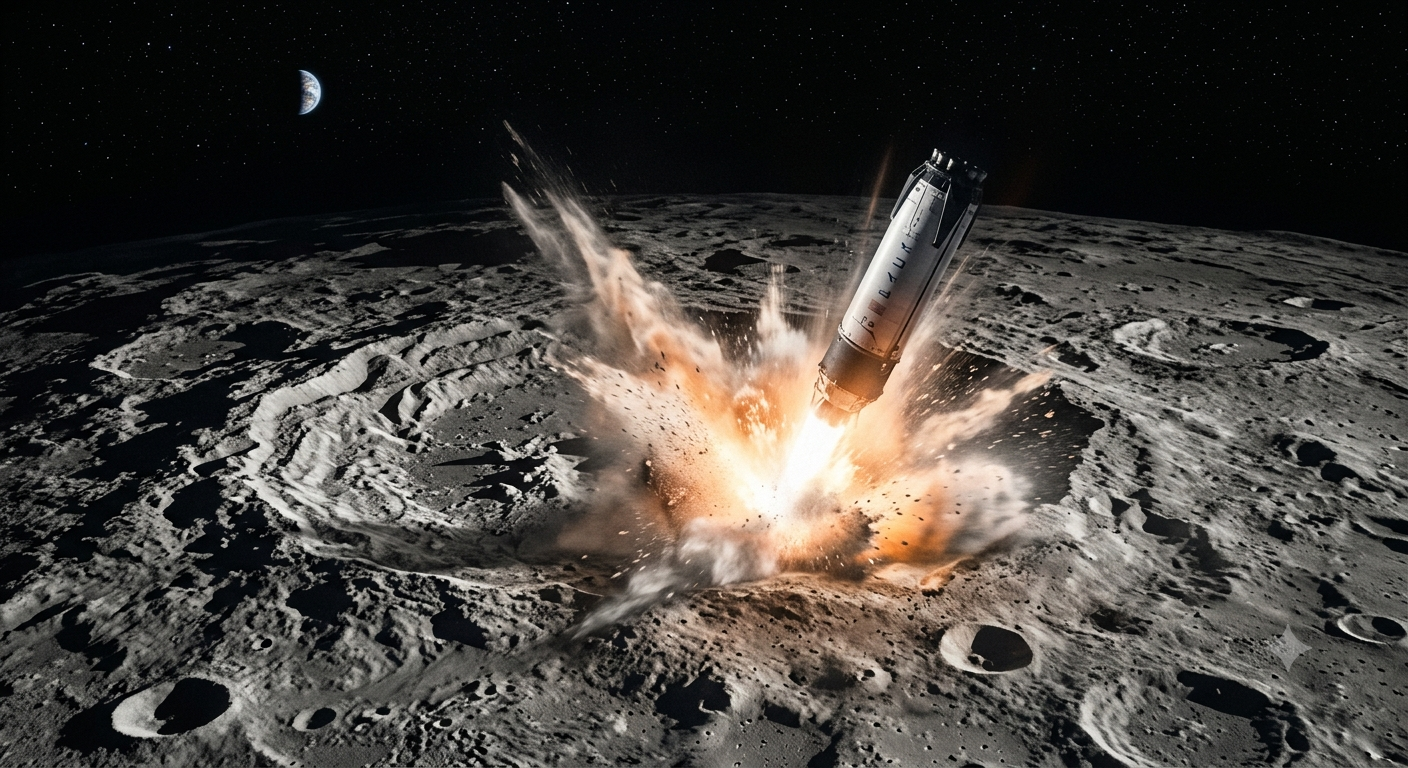
A discarded upper stage of a SpaceX Falcon 9 rocket collided with the Moon. The event occurred after the 4-tonne, school-bus-sized piece of hardware drifted through deep space for roughly 18 months following a lunar launch.
What Happened
The Object: The second stage of a SpaceX Falcon 9 rocket launched on January 15, 2025. It had deployed two commercial landers (Firefly’s Blue Ghost-1 and ispace’s Hakuto-R) toward lunar orbit.
The Impact Details: The spent rocket stage struck the lunar surface near Einstein Crater on the Moon’s Earth-facing northern hemisphere at an estimated speed of 5,400 mph (8,700 km/h).
Energy Output: The kinetic collision released energy equivalent to approximately 3 tons of TNT, gouging out a new crater estimated to be roughly 60 to 100 feet wide and 12 to 16 feet deep.
Why Did It Hit the Moon?
Unlike standard Falcon 9 upper stages—which re-enter Earth’s atmosphere and burn up safely over oceans—this mission required extra thrust to send payloads into deep space.
Once the engine exhausted its fuel, the booster remained in a wide, erratic high-altitude orbit. Over 18 months, a combination of gravitational pulls (from Earth, the Moon, and the Sun) and solar radiation pressure gradually altered its path until it intersected with the lunar surface. SpaceX confirmed the trajectory leading to the impact was unintentional but unpreventable once the stage ran out of steerable fuel.
Scientific Observations & Data Captured
Because the exact mass, velocity, and trajectory of the rocket stage were known ahead of time, scientists viewed the impact as a rare, valuable natural experiment:
Gas & Dust Plume: Using the European Southern Observatory’s Very Large Telescope (VLT) in Chile and observation sites in North America, astronomers captured spectral signals from a dust and gas plume. The plume contained traces of sodium (blasted from the lunar soil) and lithium (originating from the rocket stage hardware itself).
Orbital Photography: Space agencies are using NASA’s Lunar Reconnaissance Orbiter (LRO) and South Korea’s Danuri orbiter to photograph the crash zone. By comparing “before and after” surface images, geologists will measure how deep materials were excavated from beneath the crust.
Broader Context & Safety
No Threat to Earth: NASA and planetary scientists confirmed the impact posed zero threat to Earth or existing satellite infrastructure.
Historical Precedent: While human-made space hardware has hit the Moon before—including deliberate disposals during the Apollo and LCROSS missions—accidental deep-space stage impacts remain uncommon.
Space Debris Debates: The incident has reignited discussions among space agencies about long-term orbital debris protocols for missions traveling beyond low-Earth orbit.