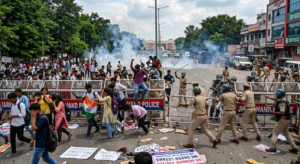
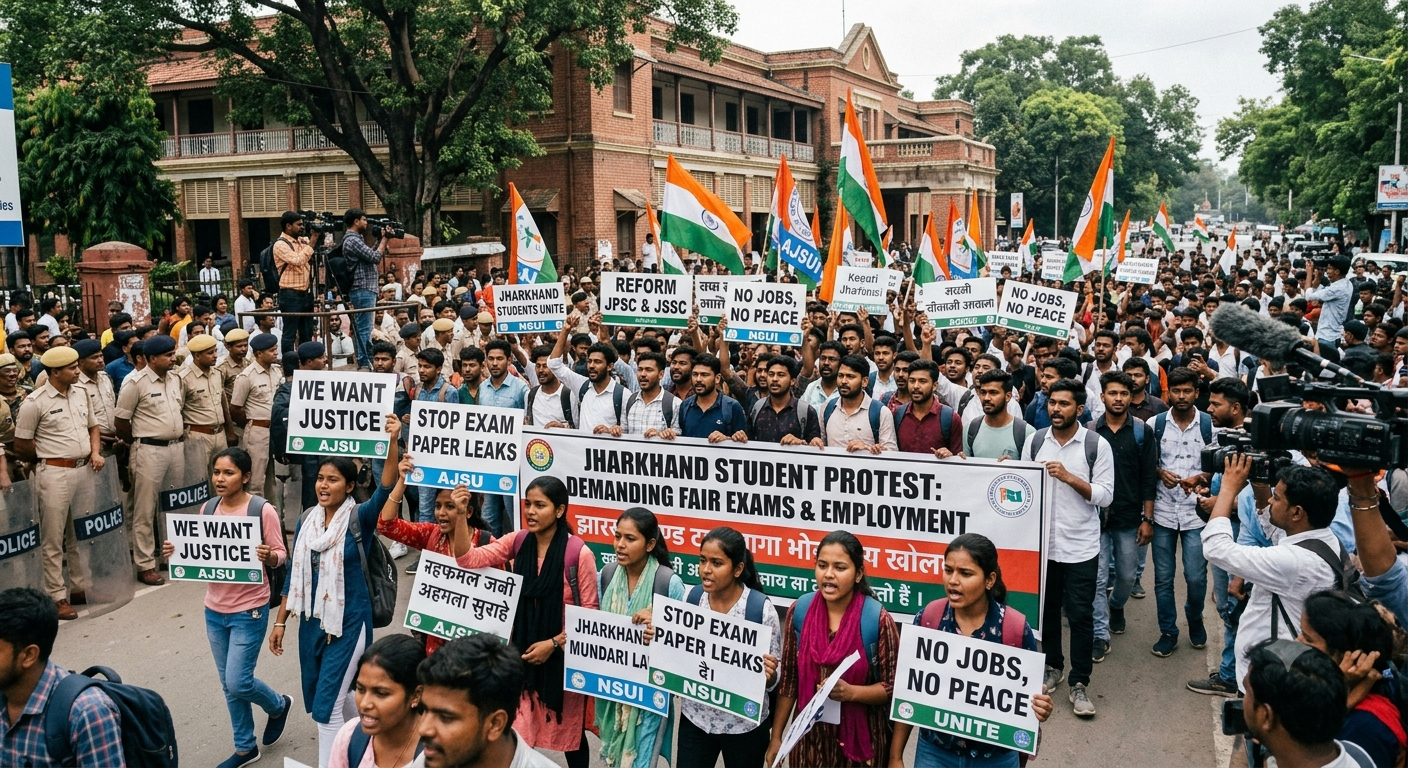
Across the state of Jharkhand, thousands of civil service aspirants and job seekers have taken to the streets in a sustained wave of protests. Triggered by alleged leaks, score inflation, and procedural transparency breaches in competitive recruitment examinations conducted by the Jharkhand Public Service Commission (JPSC) and the Jharkhand Staff Selection Commission (JSSC), the movement has rapidly evolved into a major political and administrative crisis for the state government. Centered at Ranchi’s Jaipal Singh Munda Stadium and extending across key urban hubs, the agitation underscores deep-seated anxieties over public sector employment, administrative integrity, and socio-economic mobility.
1. Context and Immediate Catalysts
Public sector employment remains one of the primary avenues for upward social mobility in Jharkhand. For years, aspirants invest substantial time, financial resources, and personal sacrifices to prepare for recruitment exams. However, a history of administrative delays, litigation, and recurring allegations of compromised examination processes created a volatile backdrop.
Primary Triggers
The 14th JPSC Preliminary Examination Controversy: Following the release of the preliminary results, allegations emerged regarding leaked answer sheets, irregular roll-number sequencing among top scorers, and missing/tampered Optical Mark Recognition (OMR) sheets.
JSSC Recruitment Irregularities: Concerns over paper leaks in various graduate-level and departmental recruitment tests conducted by third-party private testing agencies (notably under the scanner, such as TDPL) added fuel to the fire.
Institutional Distrust: Aspirants cited a pattern of lack of transparency, lack of an unedited master answer key, and delayed response to candidate grievances by exam authorities.
2. Dynamic Tactics and Core Demands of the Protesters
Organized under unified banners such as the Joint Students Front and the JPSC-JSSC Reforms Manch, the agitation has stood out for its disciplined yet creative resistance tactics.
Modes of Protest
Indefinite Hunger Strikes: Prominent student leaders, including Devendra Nath Mahto, initiated fasts-unto-death, leading to several hospitalizations and intensifying pressure on the government.
Creative Resistance: Demonstrators used symbolic actions such as mock “Naukri Bikri Kendra” (Job Sale Centers), “rate cards” representing alleged bribe prices for government posts, and recitations from classical literature (e.g., Krishna Ki Chetavani) to maintain public engagement and high morale.
Statewide Mobilization & Marches: Mass sit-ins at Jaipal Singh Munda Stadium escalated into planned Assembly (Vidhan Sabha) marches.
3. State Response and Political Dimensions
The response from the state government and executive agencies has alternated between law-enforcement measures, investigative concessions, and political outreach.
Executive and Legal Steps
Special Investigation Team (SIT) & CID Probes: State agencies arrested over 19 individuals involved in systemic paper leaks and questioned key commission executives. The state also agreed to involve the Enforcement Directorate (ED) to track money laundering linked to exam rackets.
Partial Concessions: The government acceded to demands regarding the cancellation of specific compromised tests while maintaining that exams governed strictly by High Court and Supreme Court mandates could not be unilaterally scrapped without judicial oversight.
State Outreach: Chief Minister Hemant Soren publicly emphasized a stance of “Dialogue, not batons”, seeking to de-escalate tensions and proposing a committee of elite institutions (IIT-ISM, IIM Ranchi, XLRI) to redesign examination protocols.
Political Polarization: The opposition (including BJP and AJSU youth wings) extended support to the students, amplifying calls for a full Central Bureau of Investigation (CBI) probe. Conversely, the ruling coalition cautioned against the politicization of youth grievances by external political entities.
4. Key Takeaways and Socio-Economic Implications
| Domain | Key Impact & Strategic Imperative |
|---|---|
| Institutional Trust | The crisis highlights a breakdown in public trust towards state-level selection commissions, necessitating structural overhaul rather than ad-hoc fixes. |
| Youth Demographics | High unemployment rates combined with exam delays create severe economic and psychological distress among educated youth. |
| Policy Reformation | The demand for a dedicated Jharkhand Testing Agency (JTA) reflects a growing consensus toward centralizing, standardizing, and digitizing secure recruitment processes. |
| Third-Party Oversight | Reliance on private vendors for critical recruitment exams remains a vulnerability, emphasizing the need for strict auditing, encryption, and institutional accountability. |
The Jharkhand student protests reflect a broader structural challenge across many Indian states: balancing rapid public sector recruitment with uncompromising exam integrity. While the state government’s willingness to negotiate, make arrests, and involve premier academic institutions marks a step toward resolution, long-term peace depends on structural reforms—including independent audits, secure testing protocols, and swift legal accountability for leak syndicates.