


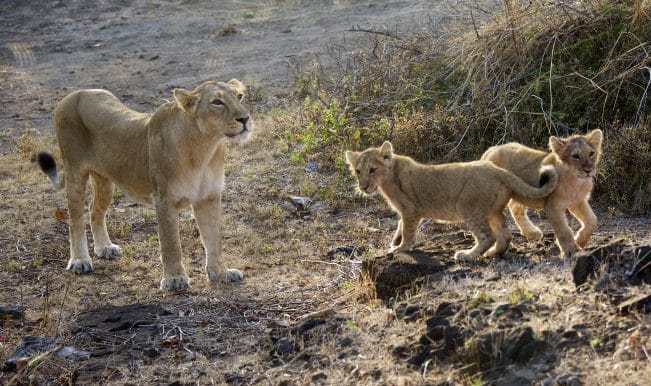
On World Lion Day, Prime Minister Narendra Modi commended India’s landmark achievements in conserving the majestic Asiatic lion, describing the recovery as a “remarkable comeback” driven by strong government initiative and deep-rooted community participation.
Sharing an insightful piece written by Union Environment Minister Bhupender Yadav, the Prime Minister highlighted how India’s commitment to wildlife preservation has transformed Gujarat’s landscape into a global model for big cat conservation.
“A remarkable comeback! India’s Asiatic lion population is thriving, with its habitat and range expanding. The Government’s unwavering commitment to conservation, backed by strong community participation, is an inspiring example of protecting our wildlife and preserving the species for generations to come.”
— Prime Minister Narendra Modi
Key Figures: A Historic Population Surge
India’s Asiatic lion population, once restricted to small pockets of the Gir forest, has registered robust growth and extensive territory expansion over the past decade:
| Metric | Growth & Scale | Key Context |
|---|---|---|
| Population Count | 891 Lions (2025) | Up 32% from 674 in 2020 and 523 in 2015. |
| Habitat Range | ~35,000 sq. km | Expanded across 11 districts in Gujarat (up from 30,000 sq km in 2020 and 6,600 sq km in 1990). |
| Wild Prey Diet | 74% of Total Diet | Dramatic shift from 1974, when wild prey constituted only 26% of their diet. |
| Barda Revival | 17 Lions | Natural re-colonization of Barda Wildlife Sanctuary after nearly 150 years of absence. |
Community Coexistence: The True Backbone of Success
Unlike many global conservation models that rely strictly on isolated sanctuaries, India’s approach relies heavily on landscape-level conservation and harmonious human-wildlife coexistence.
Local agricultural and pastoral communities, such as the Maldharis, view the lion as a cultural icon rather than a threat. This deep respect, coupled with government initiatives, has created a safe haven for the big cats:
- Safety Enhancements: Over 55,000 open wells in farm fields have been parapetted/secured to eliminate accidental drownings.
- Rail & Corridor Safety: Speed restrictions, trackside watchtowers, and trained railway loco pilots have virtually eliminated train-related lion casualties.
- Community Guardians: Local leaders (aagevaans), honorary wildlife wardens, eco-guides, and local vehicle drivers serve as frontline protectors and trackers.
- Prompt Conflict Management: Automated compensation schemes and rapid-response rescue squads maintain local trust and minimize retaliatory measures.
Project Lion & Modern Scientific Infrastructure
First announced by Prime Minister Modi on August 15, 2020, Project Lion has provided a holistic 10-year roadmap covering over 60,000 sq. km across the Saurashtra region.
Modern technology and veterinary science are key pillars of the initiative:
- Advanced Healthcare: Deployment of 11 specialized wildlife hospitals, including the Gir Wildlife Hospital, backed by the upcoming National Wildlife Disease Diagnostic and Referral Centre near Junagadh.
- Scientific Tracking: Use of satellite telemetry, microchipping, and drone surveillance to monitor lion health and movements in real time.
- Habitat Restoration: Active grassland rejuvenation and water body augmentation, encouraging natural prey density and allowing lions to establish natural territories across multi-use landscapes.
The successful return of lions to the Barda Wildlife Sanctuary in 2023—where lions had been absent since 1879—stands as living proof that dedicated habitat management and community goodwill can bring back apex predators to their historical ranges.