


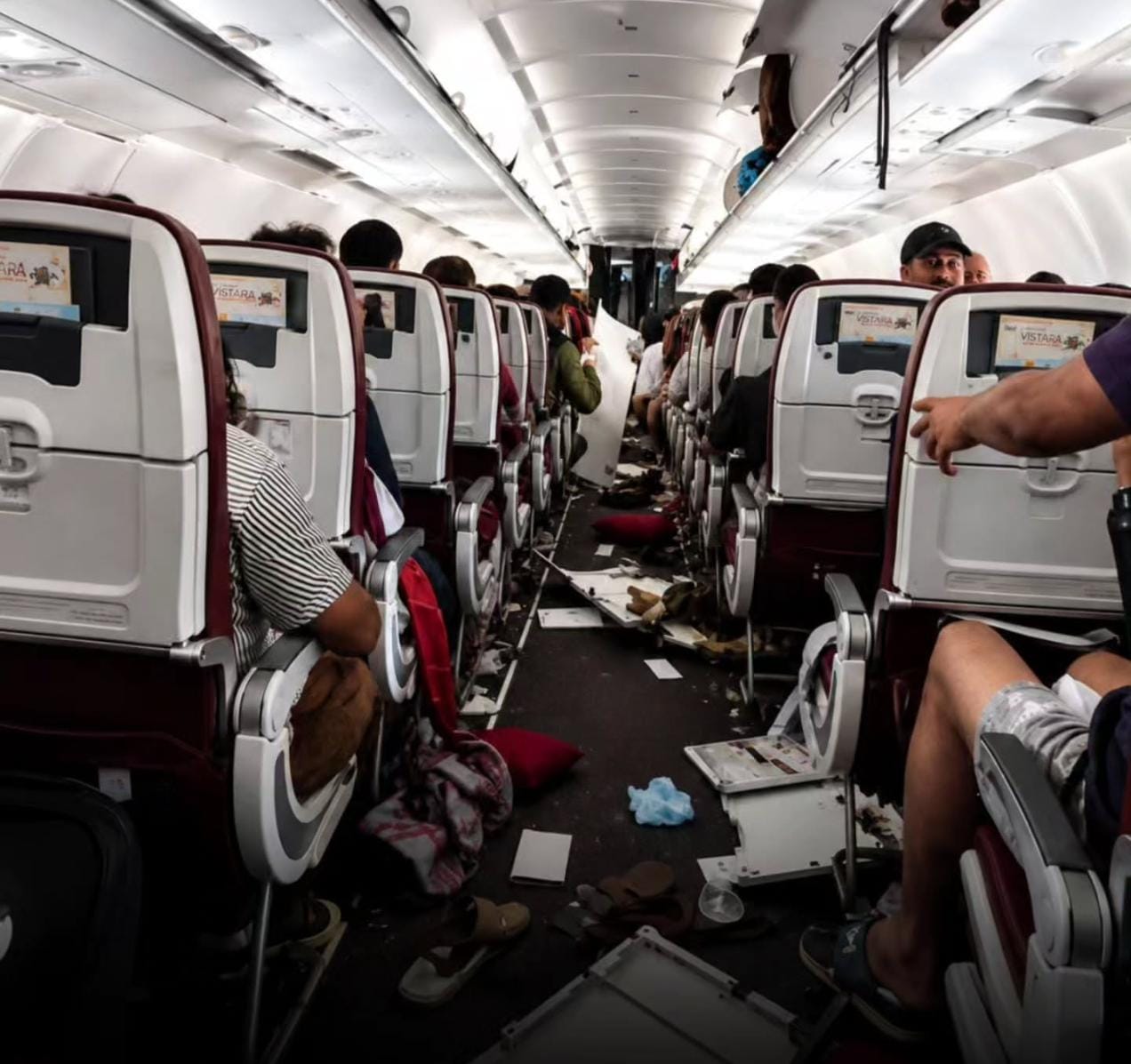
An Air India Airbus A320 aircraft (registration VT-EXO)—operating flight AI2379 from Phuket, Thailand to Delhi—experienced a severe mid-air event approximately two-and-a-half hours into its flight while cruising over Odisha.
The aircraft suddenly lost roughly 300 feet of altitude, throwing unsecured passengers and cabin crew against the interior fittings. The flight was carrying 137 passengers (including 3 infants) and 8 crew members (2 pilots and 6 cabin crew).
- Injuries: A total of 24 people were injured (20 passengers and 4 cabin crew members), with at least two crew members sustaining severe spinal injuries requiring hospitalization.
- Safe Landing: The flight crew stabilized the aircraft shortly after the drop and safely landed at Indira Gandhi International Airport in Delhi at 11:07 AM.
Evolving Narrative: Turbulence vs. Technical Failure
While Air India initially attributed the sudden descent to a “brief in-flight turbulence event”, subsequent preliminary investigation reports (PDR) and technical disclosures pointed toward a complex technical malfunction:
- Multiple Technical Anomalies: Preliminary reports indicate that the aircraft suffered an autopilot disconnection, flight-control stall warnings, and triple hydraulic system/flight-control ECAM alerts.
- Manual Intervention: The flight crew responded to the technical warnings by disengaging autopilot/taking manual control and pushing the nose down to maintain control, which triggered a sudden negative G-force and caused the altitude drop.
- Official Classification: The Ministry of Civil Aviation (MoCA) classified the event as a “serious incident” and transferred the probe to the Aircraft Accident Investigation Bureau (AAIB).
Pilot Drug Test Controversy
Following standard aviation protocols for serious incidents, both flight crew members underwent mandatory post-flight psychoactive substance screening:
| Investigation Stage | Status / Outcome |
|---|---|
| Initial Screening | The Pilot-in-Command (PIC) returned a “non-negative” result. |
| Confirmatory Laboratory Test | Confirmed positive for Marijuana (THC). |
| Immediate Action Taken | Both pilots were grounded and removed from flying duties pending investigation. |
Under Directorate General of Civil Aviation (DGCA) rules:
- A confirmed positive test leads to immediate medical review and mandatory rehabilitation for a first offense.
- A second offense results in a 3-year license suspension, while a third offense leads to permanent license cancellation.
Ongoing Investigation
The Aircraft Accident Investigation Bureau (AAIB) is leading the multi-agency probe alongside Airbus and France’s aviation safety agency, BEA. The investigation is analyzing:
- Flight Data Recorders (FDR) & Cockpit Voice Recorders (CVR) to verify the exact sequence of system warnings and control inputs.
- Human Factors & Medical Records to determine whether pilot impairment played a direct or indirect role in the aircraft’s handling.
- System Failures to confirm whether hydraulic and flight-control glitches caused the drop or were triggered as a byproduct of atmospheric forces.
The AAIB has cautioned against jumping to premature conclusions, stating that all technical, environmental, and human factors will be examined in detail before a final report is issued.