

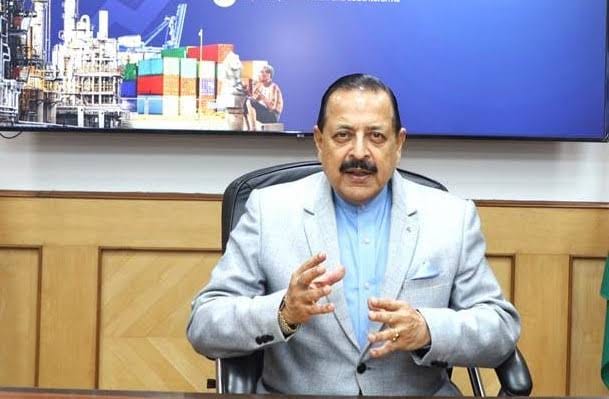
In a statement delivered to Parliament, Dr. Jitendra Singh, Union Minister of State (Independent Charge) for Science & Technology and MoS in the Prime Minister’s Office (Department of Atomic Energy), unveiled the strategic roadmap under India’s Nuclear Energy Mission.
Driven by the vision of achieving Viksit Bharat (Developed India) by 2047 and supporting the nation’s Net-Zero by 2070 commitment, India aims to scale its installed nuclear capacity from ~8.8 GWe today to 100 GWe by 2047—a more than tenfold expansion.
A central pillar of this acceleration is the deployment of at least five indigenous Small Modular Reactors (SMRs) by 2033.
Strategic Blueprint: Two-Pronged Expansion
The Department of Atomic Energy (DAE) has structured the capacity expansion across two main tracks:
1. Large-Scale Baseload Power
- Technology: 700 MWe Pressurised Heavy Water Reactors (PHWRs) alongside imported large-scale Pressurised Water Reactors (PWRs).
- Milestone: Capacity will expand from ~8.8 GWe to approximately 22 GWe by 2031–32 as projects currently under implementation are progressively commissioned.
2. Flexible Small Modular Reactors (SMRs)
- Applications: SMRs are designed for rapid deployment, factory manufacturing, and placement at brownfield sites—such as replacing aging coal-fired power plants, powering energy-intensive industries (steel, cement, chemical), and off-grid remote areas.
Indigenous SMR Designs in Development
The Bhabha Atomic Research Centre (BARC) is actively developing three indigenous SMR configurations:
| Reactor Model | Capacity | Core Technology | Primary Objective & Planned Site |
|---|---|---|---|
| BSMR-200 | 220 MWe | Pressurised Water Reactor (PWR) | Captive baseload power for heavy manufacturing (steel, aluminum, metal) located at Tarapur, Maharashtra. |
| SMR-55 | 55 MWe | Compact Modular PWR | Distributed local grid support and off-grid heavy power requirements (Tarapur, Maharashtra). |
| HTGCR | Up to 5 MWth | High-Temperature Gas-Cooled Reactor | Thermal heat source for producing green hydrogen via a copper-chlorine cycle at Visakhapatnam, Andhra Pradesh. |
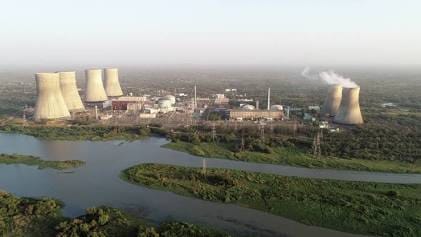
Policy & Private Sector Integration: SHANTI Act, 2025
To achieve these ambitious targets, the government enacted the landmark Sustainable Harnessing and Advancement of Nuclear Energy for Transforming India (SHANTI) Act, 2025.
Key Regulatory Changes:
- Private Sector Participation: Permits private and joint-venture commercial investments in construction, operation, equipment manufacturing, and R&D for atomic power projects.
- Funding Boost: Budget allocations include an earmarked ₹20,000 crore ($2 billion) R&D fund specifically for the Nuclear Energy Mission and SMR technology development.
- Regulatory Reinforcement: Grants formal statutory authority to the Atomic Energy Regulatory Board (AERB) to streamline licensing while maintaining safety standards.
dards.
Advancing the Three-Stage Program & Thorium Utilization
Dr. Jitendra Singh emphasized that long-term energy independence rests on India’s three-stage nuclear roadmap:
- Stage 1 (PHWRs): Utilizing natural uranium to generate power and plutonium.
- Stage 2 (Fast Breeder Reactors): Led by the Indira Gandhi Centre for Atomic Research (IGCAR), operating Sodium-Cooled Fast Breeder Reactors (such as PFBR at Kalpakkam) to multiply fissile fuel reserves.
- Stage 3 (Thorium Fuel Cycle): Tapping into India’s vast domestic thorium reserves. Thorium-232 is converted into fissile Uranium-233 within reactors. BARC and IGCAR continue pilot operations using Thoria fuel in reactors like KAMINI.