
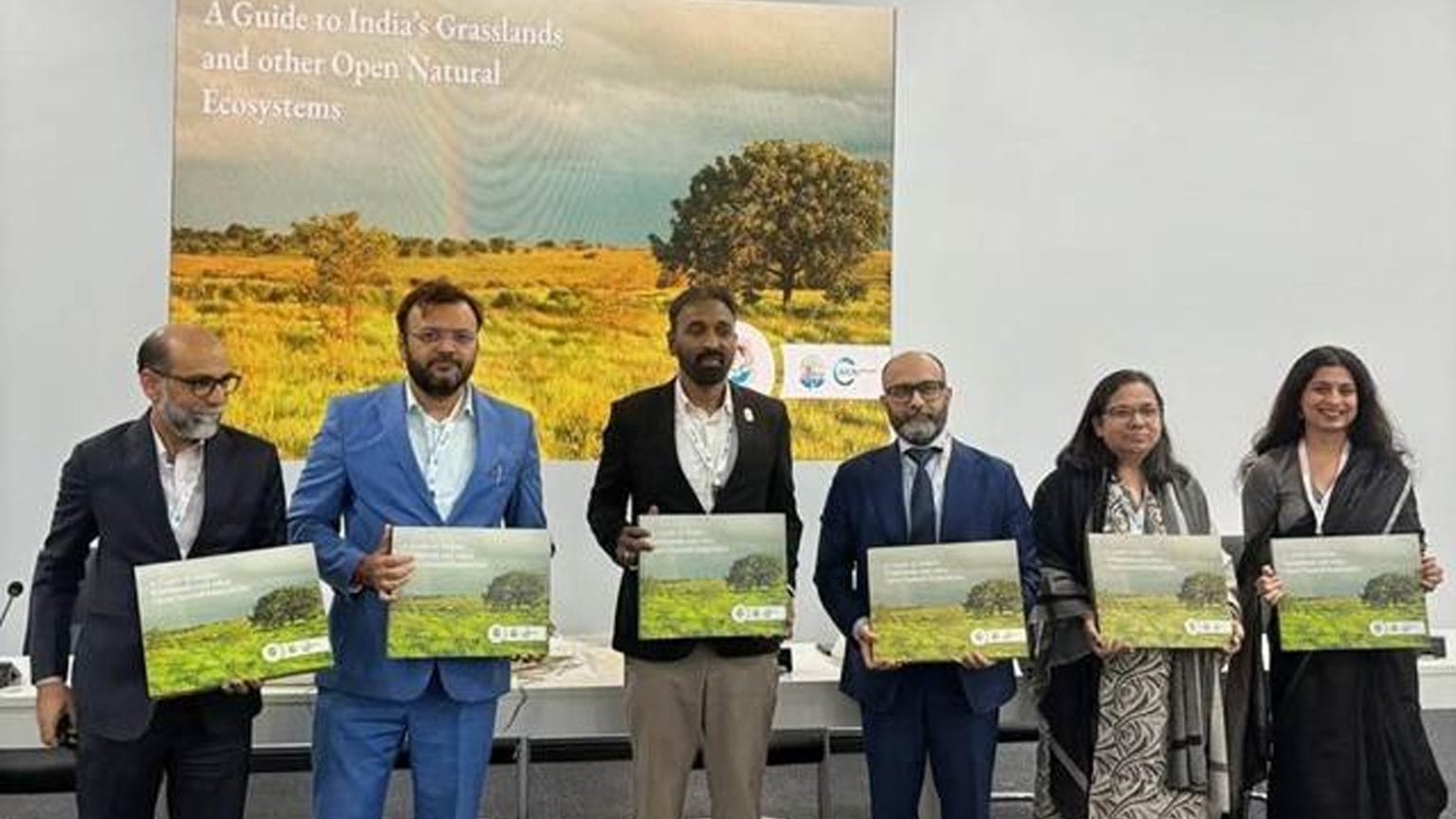
India officially launched its first-ever Guide to Grasslands and Other Open Natural Ecosystems (ONEs) of India at the 17th Session of the Conference of the Parties (COP17) to the United Nations Convention to Combat Desertification (UNCCD) in Ulaanbaatar, Mongolia.
The release marks a paradigm shift in Indian ecological governance, formally recognizing non-forested biomes—which have historically been misclassified as unproductive “wastelands”—as critical pillars of climate resilience, biodiversity, and pastoral livelihoods.
1. Background and Context
For centuries, environmental policy in India and much of the Global South heavily prioritized forest cover. Non-forest landscapes—such as open savannas, alpine meadows, semi-arid scrublands, and rocky plateaus—were frequently labeled in colonial land records as “wastelands” or degraded terrain. This led to indiscriminate conversion of open ecosystems for intensive agriculture, solar energy parks, industrial projects, or invasive monoculture afforestation drives.
The launching of this Guide at UNCCD COP17 addresses these systemic gaps, aligning directly with COP17’s central theme: “Restoring Land, Restoring Hope”. Because COP17 is hosted in Mongolia—a nation heavily reliant on healthy rangelands and pastoralism—the global platform underscored the urgency of protecting open natural ecosystems globally.
2. Key Highlights of the Guide
The publication compiles scientific literature, geospatial insights, and community-level data across India’s open natural ecosystems.
- Comprehensive Ecological Mapping: The guide details major ONEs across distinct geographical zones, including:
- High-altitude Himalayan and sub-Himalayan Terai grasslands.The arid landscapes of Thar and Banni (Gujarat).Deccan savannas and peninsular rocky plateaus.Ravines, dry tropical scrublands, and coastal salt marshes.
- Revisiting the “Wasteland” Narrative: The document systematically challenges the historical view of open ecosystems as areas lacking tree cover, highlighting their role in regulating localized water cycles, preventing soil erosion, and storing vast quantities of below-ground carbon in their extensive root systems and soil.Biodiversity Hotspots: ONEs shelter endemic, highly specialized megafauna and avifauna that cannot survive in dense forests, including the Great Indian Bustard, Lesser Florican, Blackbuck, Indian Wolf, Chinkara, and various raptor species.Support for Pastoral & Local Communities: The guide highlights traditional land-use models such as Orans (sacred groves and pastures) and Gauchars (community grazing lands). It documents how millions of pastoralists depend on these landscapes for livestock rearing and sustainable agriculture.
3. High-Level Addresses and Official Statements The unveiling of the guide featured a video address by Union Minister for Environment, Forest and Climate Change, Shri Bhupender Yadav. “Grasslands, scrublands, and ravines have for too long been judged simply by the absence of trees, despite these ecosystems sheltering species found nowhere else on earth and sustaining pastoral communities… Modern science reinforces the understanding of local communities that healthy grasslands are indispensable for biodiversity, livelihoods, and climate resilience.”— Bhupender Yadav, Union Environment Minister
The Minister shared personal anecdotes of growing up in Ajmer, Rajasthan, surrounded by grazing lands that were routinely categorized as degraded wasteland. He emphasized that community-led conservation systems like Orans demonstrate how indigenous ecological knowledge aligns with modern climate science.
4. Policy Significance and Global Alignment
| Area | Strategic Impact |
|---|---|
| Land Degradation Neutrality (LDN) | Helps India track and achieve its LDN targets under UNCCD by prioritizing ecosystem-appropriate restoration over indiscriminate tree planting. |
| Carbon Accounting | Shifts climate mitigation strategies to include below-ground soil carbon sequestration typical of deep-rooted grasses and shrublands. |
| Science-Based Planning | Provides a standardized benchmark for environmental impact assessments (EIAs), preventing damaging land diversions in sensitive ONE regions. |
| Pastoralist Rights | Strengthens policy backing for nomadic and semi-nomadic pastoralists, securing grazing rights and community land stewardship. |
5. Next Steps
The guide is intended as a core resource for state forest departments, conservation practitioners, land-use planners, researchers, and climate policy developers. Going forward, experts at COP17 called for enhanced remote sensing mapping of open natural ecosystems, localized restoration guidelines, and integration into national biodiversity action plans to ensure these long-overlooked biomes receive protection alongside forest reserves.