
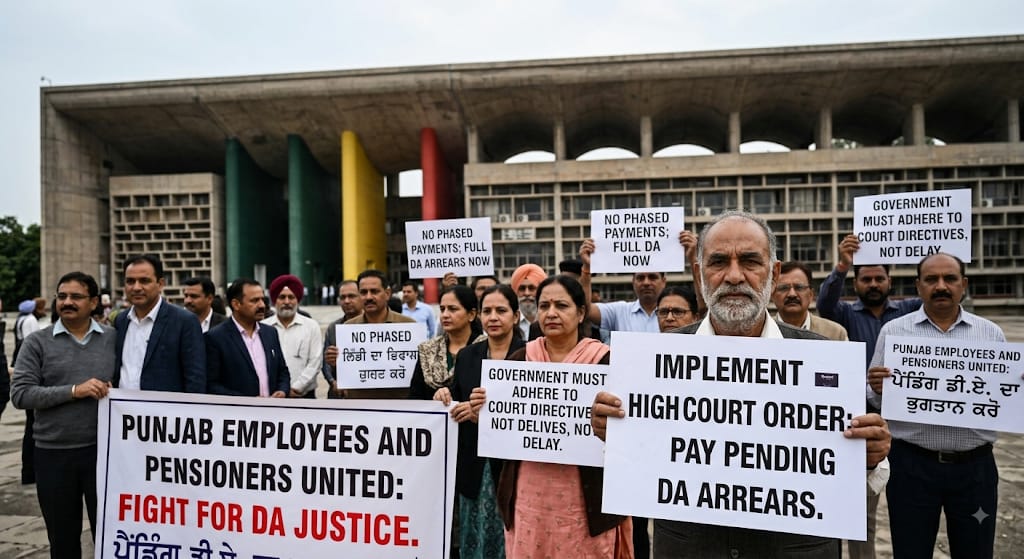
The legal battle over pending Dearness Allowance (DA) and Dearness Relief (DR) arrears for nearly 7.5 lakh active employees and pensioners of the Punjab Government (along with state corporations such as PSPCL) has reached a critical stage in the Punjab & Haryana High Court and the Supreme Court of India.
1. Core Subject Matter of the Case
- Parity with Central Pattern & All India Services (AIS): The petitioners (government employees, educational staff, secretarial workers, and pensioners) argued that while All India Service officers (IAS/IPS/IFS) posted in Punjab were receiving full DA benefits on the Central Government pattern (around 58%), state government employees and pensioners were restricted to much lower slabs (e.g., 42%), leading to unconstitutional discrimination.
- Rejection of the “Liquidation Plan”: The Punjab Government had proposed a staggered, age-based phased plan stretching up to 2028 (in up to 42 installments) to pay off pending arrears. Employees challenged this plan as arbitrary and a violation of Article 14 of the Constitution of India.
- Financial Burden: The State Government estimates the immediate financial liability for clearing pending DA arrears at over ₹14,000 crore to ₹25,000 crore.
2. Legal Timeline & Key Rulings
Single-Judge Bench Verdict (April 8, 2026)
- The single-judge bench ruled in favor of state employees and pensioners, setting a strict deadline of June 30, 2026, for the Punjab Government to release pending DA/DR dues on par with Central Government rates.
- The court struck down the state’s multi-year staggered payment plan and held that financial constraints cannot be used as an excuse to deny inflation-linked statutory dues.
State Appeal & Division Bench Verdict (August 3, 2026)
- The Punjab Government and PSPCL filed Letters Patent Appeals (LPAs) arguing that mandatory immediate disbursement enters the domain of fiscal policy and would disrupt state financial administration.
- The High Court Division Bench dismissed the government’s appeals and upheld the single-judge bench order.
- The court directed the state to release all pending DA dues to employees and pensioners within two weeks.
Contempt Proceedings & Supreme Court Caveats (August 2026)
- Civil Original Contempt Petition (COCP) Context: Following the non-compliance with the court-mandated deadline, contempt petitions were pressed before the High Court to seek compliance or penal action/interest against responsible executive authorities.
- Caveats Filed in Apex Court: Anticipating that the Punjab Government would challenge the High Court’s directives via a Special Leave Petition (SLP), employee unions proactively filed caveats in the Supreme Court. This ensures that the Supreme Court cannot grant any ex-parte stay or interim relief to the state without first hearing the representation of the employees.
3. Key Arguments Raised
| Party | Major Legal Arguments |
|---|---|
| Employees & Pensioners | • DA is an inflation-neutralizing right, not a discretionary bonus.• Arbitrary discrimination: IAS/IPS officers get full DA while state staff is denied.• The staggered payment plan up to 2028 is unconstitutional. |
| Punjab Government | • Immediate lump-sum payout of ₹14,000–₹25,000 crore will paralyze state development funds.• Courts should refrain from overriding executive fiscal policy and structured budget allocation.• Demanded that if central DA rates apply, pay scale structures should also match central norms. |
Summary of Current Position
With the Division Bench upholding the mandate to clear pending DA dues and contempt proceedings looming over non-compliance, the legal battle has now shifted toward the Supreme Court, where employee caveats are active to prevent any unilateral stay on the High Court’s directive.