



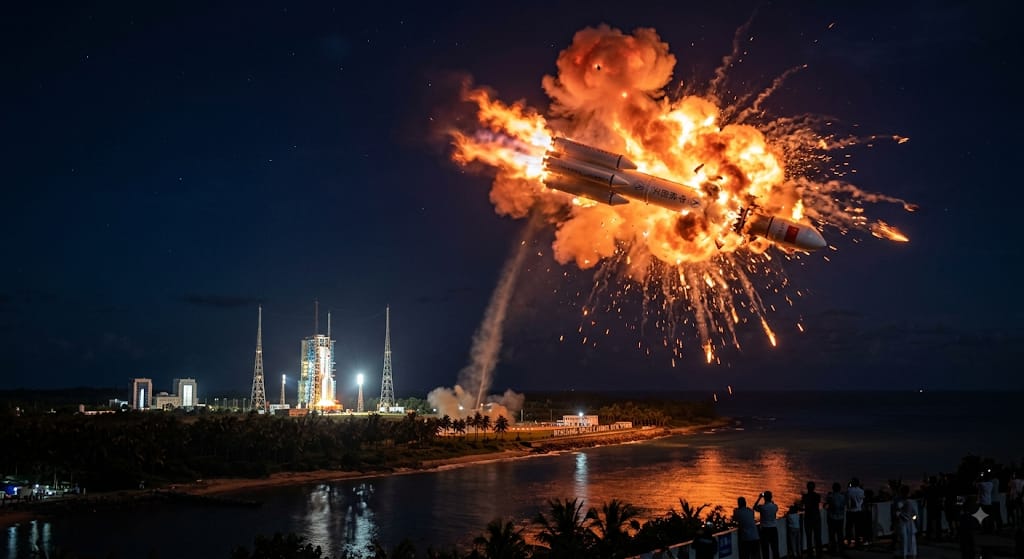
On August 10, 2026, at 8:02 PM local time (12:02 GMT), a Chinese Long March 7A (CZ-7A) heavy-lift launch vehicle experienced a catastrophic flight anomaly shortly after liftoff from the Wenchang Space Launch Site on Hainan Island. The rocket exploded in mid-air, destroying its primary payload, the Zhongxing-4B (ChinaSat-4B) communications satellite.
This event marks the second operational failure of the Long March 7A variant across 18 orbital missions, dealing a temporary setback to Beijing’s satellite communications expansion.
Key Mission & Event Details
- Launch Vehicle: Long March 7A (3-stage medium-to-heavy lift rocket designed by the China Academy of Launch Vehicle Technology – CALT).
- Primary Payload: Zhongxing-4B (ChinaSat-4B) — A broad-spectrum communications satellite intended for geostationary orbit to provide television, radio, and high-speed data connectivity.
- Launch Site: Wenchang Space Launch Site, Hainan Province.
- Flight Timeline: The anomaly occurred approximately 85 seconds post-liftoff during the first-stage flight phase, near the window of maximum dynamic pressure (\text{Max-}Q).
- Outcome: Loss of launch vehicle and payload; mid-air breakup over water/coastal boundary.
Incident Timeline & Media Coverage
| Time (GMT / Local) | Event Milestone |
|---|---|
| Aug 10, 12:02 GMT | Liftoff of Long March 7A from Wenchang Pad 2. |
| T+85 Seconds | Visual tracking shows structural/propulsion failure followed by mid-air explosion. |
| T+3 Hours | Official confirmation issued via Xinhua acknowledging a “flight anomaly” during ascent. |
| Aug 11, 2026 | International tracking agencies and commercial observers confirm total loss of vehicle and payload. |
“State news agency Xinhua confirmed the failure three hours post-launch, stating that the vehicle experienced an anomaly during ascent. An official investigation team has been formed to determine the root cause.”
Technical & Strategic Implications
1. Launch Reliability Profile
The Long March 7A is a core component of China’s geostationary transport infrastructure. Having debuted in 2020 (which also suffered a maiden flight failure before achieving a streak of successful missions), this second failure raises engineering scrutiny surrounding stage-separation mechanics, engine pressure stability, or structural integrity under peak aerodynamic stress.
2. Space Debris & Operational Impact
Because the explosion occurred at a relatively low altitude during early ascent (~85 seconds into flight), the vast majority of debris is expected to have re-entered the atmosphere over regional water hazard zones, posing minimal long-term debris threat to low Earth orbit (LEO) infrastructure compared to high-altitude upper-stage breakups.
3. Immediate Operations Outlook
China’s aerospace authorities have initiated a technical review. Launch schedules utilizing the Long March 7 series—including cargo missions slated for the Tiangong Space Station—may experience minor safety holds pending preliminary telemetry analysis.